
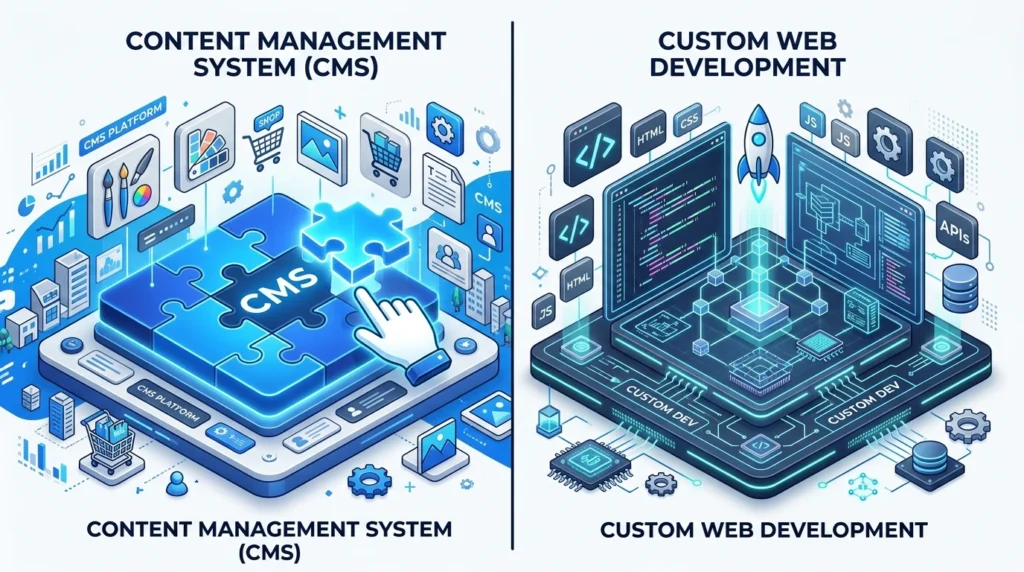
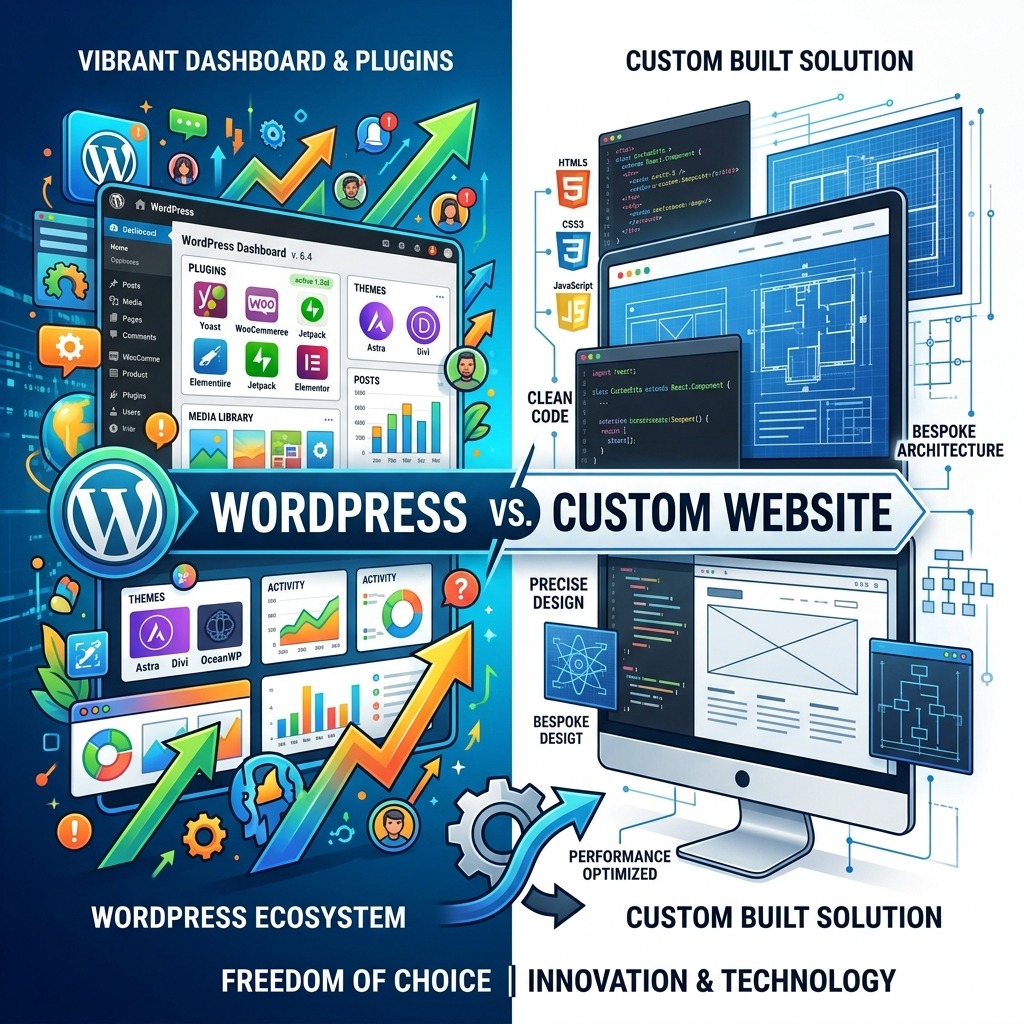
WordPress is a content management system that powers over 43% of all websites, offering speed and affordability. A custom website is built from scratch, offering full control and scalability. WordPress suits most small-to-medium businesses; custom development is better for complex, unique functionality requirements.
Choosing how to build your website is one of the most consequential decisions you’ll make for your business. Get it right, and your site becomes a growth engine. Get it wrong, and you’re looking at costly rebuilds, frustrated users, and missed opportunities.
The debate between WordPress and custom website development has been going on for years—and for good reason. Both options have real merit, but they serve very different needs. The right choice depends on your budget, timeline, technical resources, and long-term goals.
This post breaks down everything you need to know: how each option works, what it costs, where each one excels, and which is the smarter pick for your specific situation.
What Is WordPress and How Does It Work?
WordPress is an open-source content management system (CMS) that allows users to build and manage websites without writing code from scratch. Originally launched in 2003 as a blogging platform, WordPress has evolved into a full-featured website builder used by everyone from solo bloggers to Fortune 500 companies.
WordPress websites are built on a foundation of themes (which control design) and plugins (which extend functionality). With over 59,000 plugins available in the official WordPress directory, you can add almost any feature imaginable—e-commerce, booking systems, contact forms, SEO tools—without touching a line of code.
According to W3Techs (2024), WordPress powers 43.5% of all websites on the internet. That level of adoption means a massive ecosystem of developers, designers, themes, and resources.
What Are the Main Advantages of WordPress?
- Speed to launch: A WordPress site can go live in days, not months.
- Cost-effective: Premium themes range from $30–$100. Hosting starts as low as $5/month.
- User-friendly: Non-technical users can update content, add blog posts, and manage pages with ease.
- Large community: Thousands of tutorials, forums, and developers available globally.
- SEO-ready: Plugins like Yoast SEO and Rank Math make on-page optimization accessible to anyone.
What Are the Main Disadvantages of WordPress?
- Security vulnerabilities: WordPress’s popularity makes it a frequent target for hackers. Regular updates and security plugins are essential.
- Plugin conflicts: Using too many plugins can slow down your site or cause compatibility issues.
- Performance limitations: Without proper optimization, WordPress sites can become slow—especially on shared hosting.
- Design constraints: Even with page builders like Elementor or Divi, you’re still working within a theme’s structure.
What Is a Custom Website and How Is It Built?
A custom website is built from scratch by developers using programming languages like HTML, CSS, JavaScript, PHP, Python, or frameworks like React, Next.js, or Laravel. There are no pre-built templates or plugins. Every feature, layout element, and interaction is designed and coded specifically for your project.
Custom development gives you complete control over how your website looks, functions, and scales. It also means your site is unique—no two businesses will ever have the same codebase.
What Are the Main Advantages of a Custom Website?
- Unlimited flexibility: Developers can build any feature or functionality you can imagine, with no workarounds.
- Performance optimization: Code is written specifically for your needs, with no bloat from unused plugin features.
- Stronger security: No publicly known vulnerabilities from popular plugins or themes.
- Scalability: Custom architecture can be designed to handle growth—more users, more data, more complexity.
- Brand differentiation: A custom site reflects your brand precisely, with no design limitations.
What Are the Main Disadvantages of a Custom Website?
- High upfront cost: Custom development typically ranges from $10,000 to $100,000+ depending on complexity.
- Longer timelines: A custom site can take weeks to months to build, even for experienced teams.
- Ongoing maintenance: You’ll need developer support for updates, bug fixes, and new features.
- Harder to hand off: Without a CMS layer, non-technical team members may struggle to update content independently.
WordPress vs Custom Website: A Side-by-Side Comparison
| Factor | WordPress | Custom Website |
| Cost | Low–Medium ($500–$5,000) | High ($10,000–$100,000+) |
| Build time | Days to weeks | Weeks to months |
| Design flexibility | Moderate | Unlimited |
| Performance | Moderate (optimizable) | High |
| Security | Moderate (manageable) | High |
| Ease of use | High | Low |
| Scalability | Moderate | High |
| Best for | SMBs, blogs, portfolios | SaaS, enterprise, complex apps |
How Much Does a WordPress Website Cost Compared to a Custom Website?
Cost is usually the deciding factor for small and medium-sized businesses.
A basic WordPress website—using a premium theme, a few plugins, and managed hosting—can cost as little as $500 to $3,000 when built by a freelance developer. A more complex WordPress site with custom design work and advanced plugins might reach $5,000 to $15,000.
Custom website development sits in a completely different range. A simple custom site starts around $10,000, while complex web applications or enterprise platforms routinely exceed $100,000. Ongoing developer maintenance adds to this cost annually.
The gap in cost reflects the gap in labor. WordPress compresses development time significantly. Custom development requires building every component from scratch.
Choose WordPress if your budget is under $10,000 and your needs are standard.
Choose a custom website if you have specialized functionality needs that no plugin can solve, and budget is not a primary constraint.
Which Platform Offers Better SEO: WordPress or Custom?
Both WordPress and custom websites can achieve strong SEO results—but through different paths.
WordPress has a significant built-in advantage for non-developers. Plugins like Yoast SEO and Rank Math provide guided optimization for meta titles, descriptions, sitemaps, structured data, and readability. This makes technical SEO accessible to marketing teams without developer support.
Custom websites offer superior performance potential. Google’s Core Web Vitals—which measure page speed, visual stability, and interactivity—are a confirmed ranking factor. A well-built custom site, free from plugin bloat, can achieve near-perfect performance scores. WordPress sites can also hit top performance benchmarks, but they require more deliberate optimization (caching, image compression, minimal plugins).
For most businesses, WordPress is the faster path to solid SEO performance. For high-traffic, performance-critical applications, a custom-built site may have the edge.
When Should You Choose WordPress Over a Custom Website?
WordPress is the smarter choice in these situations:
- You’re a small business or startup with a limited budget and a standard set of website needs (service pages, a blog, a contact form).
- You need to launch quickly. A WordPress site can be live within a week.
- Your team needs to manage content independently. WordPress’s dashboard is one of the most intuitive CMS interfaces available.
- You’re building a blog, portfolio, or brochure site. These are WordPress’s core strengths.
- You’re running an e-commerce store. WooCommerce—WordPress’s e-commerce plugin—is used by 6.6 million websites globally (BuiltWith, 2024).
When Should You Choose a Custom Website Over WordPress?
Custom development makes more sense when:
- Your product is the website. SaaS platforms, marketplaces, and complex web applications need architecture that no off-the-shelf CMS can support.
- You have unique functionality requirements. If you need features that no plugin offers, custom is your only real option.
- Performance is mission-critical. High-traffic platforms that cannot afford latency or downtime benefit from purpose-built infrastructure.
- Security and compliance matter. Industries like healthcare, finance, and legal often require custom-built solutions to meet regulatory standards.
- You’re building for scale. If you anticipate rapid user growth, a custom architecture designed for scalability will serve you better in the long run.
Can You Use WordPress as a Foundation for a Semi-Custom Website?
Yes—and this is a popular middle-ground approach. Many businesses use WordPress as their CMS while hiring developers to build custom themes, custom Gutenberg blocks, or entirely bespoke page templates. This approach combines WordPress’s ease of content management with a unique, brand-specific design.
Headless WordPress is another growing option. Headless WordPress uses the WordPress back end to manage content, but delivers it through a custom-built front end using frameworks like React or Next.js. This setup offers superior performance and design flexibility while retaining the familiar WordPress editorial experience.
This hybrid approach suits businesses that want a distinctive, fast website without committing to full custom development.
Making the Right Decision for Your Website
There’s no universally correct answer—only the right fit for your goals, resources, and timeline.
WordPress wins on accessibility, cost, speed, and ease of use. For most businesses—especially those building their first website or operating with lean teams—WordPress delivers excellent results at a fraction of the cost of custom development.
Custom websites win on flexibility, performance, security, and scalability. For tech companies, SaaS products, and enterprises with complex requirements, the investment in custom development pays off in ways a WordPress site simply cannot match.
Before you decide, ask yourself three questions:
- What functionality do I actually need? If plugins can cover it, WordPress is likely sufficient.
- What is my realistic budget and timeline? If both are limited, WordPress is the pragmatic choice.
- Where does this website need to be in three years? If you anticipate complexity, plan for it now.
Start with what serves your current needs—then build toward your future ones.
Frequently Asked Questions
Is WordPress good for SEO compared to a custom-built website?
Both WordPress and custom websites can rank well in search engines. WordPress has a practical advantage for non-developers thanks to plugins like Yoast SEO, which simplify technical optimization. Custom websites can achieve superior Core Web Vitals scores due to cleaner, leaner code. For most businesses, WordPress provides excellent SEO performance with less effort.
How long does it take to build a WordPress website vs a custom website?
A WordPress website can typically be built and launched within one to four weeks, depending on complexity. A custom website generally takes two to six months, sometimes longer for complex applications. The timeline difference is largely due to the pre-built components available in WordPress versus the from-scratch development required for custom builds.
Is a custom website more secure than a WordPress website?
Custom websites are generally considered more secure because they don’t rely on publicly known plugins or themes that hackers actively target. However, a well-maintained WordPress site—with regular updates, strong passwords, and a security plugin like Wordfence—can be highly secure. The risk with WordPress typically comes from outdated plugins or poor maintenance practices.
Can I switch from WordPress to a custom website later?
Yes, but the process involves rebuilding your site from scratch. Content can often be migrated, but the design and functionality will need to be rebuilt by developers. Many businesses start on WordPress and transition to a custom solution once their needs—and budget—justify it.
What is headless WordPress and is it worth considering?
Headless WordPress decouples the WordPress back end (where content is managed) from the front end (how it’s displayed). The content is served through an API to a custom-built front end using frameworks like React or Next.js. This approach delivers faster performance and greater design freedom while preserving the familiar WordPress content management experience. It’s worth considering for businesses that want the best of both worlds.
How much does it cost to maintain a WordPress site vs a custom site?
WordPress maintenance costs are relatively low—typically $50 to $300 per month for hosting, plugin updates, and basic support. Custom website maintenance varies widely based on complexity but generally starts around $500 per month for developer support and infrastructure. Budget for ongoing maintenance regardless of which platform you choose.